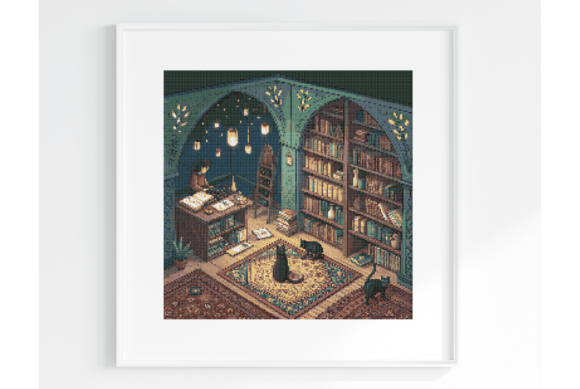
Cozy Bookshop Cat Cross Stitch Pattern
A Designer’s First Glance: Warmth, Whimsy, and Stitchable Charm
Opening the Cozy Bookshop Cat Cross Stitch Pattern, I felt an immediate lift — not just from the orange tabby curled among trailing ivy and stacked hardcovers, but from how thoughtfully the composition breathes. This isn’t a tight, fussy chart. It’s generous in negative space, with soft edges on the plant leaves and gentle curves in the cat’s posture. The mood is unhurried and inviting — exactly what you’d want stitched onto a pillow cover for a reading nook or framed as nursery decor. As a designer who regularly selects patterns for client embroidery projects, I notice right away that this one leans into *narrative texture*: the teacup on the shelf, the open book beside the cat, the subtle botanical layering — all suggest story, not just silhouette. That makes it ideal for handmade products where emotional resonance matters more than bold graphic impact.
Where It Shines: Real Projects, Real Customers
I recently tested the Cozy Bookshop Cat Cross Stitch Pattern as the centerpiece for a custom embroidered linen tote bag — a popular item for indie bookshops and literary-themed gift shops. On natural linen, the soft orange thread (DMC 742) popped without shouting, and the moderate stitch density held up beautifully without stiffening the fabric. Customers responded strongly to the quiet storytelling: “It feels like my favorite corner of the world,” one said. That kind of reaction is gold for Etsy sellers and small shop owners building brand warmth.
The pattern also translated well onto a cotton tea towel — printed mockups had suggested it might read too softly, but stitched, the contrast between the cat’s fur and the leafy background gave enough definition at 6–8 inches wide. For baby embroidery? Yes — especially on organic cotton burp cloths or crib bumpers — but only if stitched with high-contrast thread (e.g., dark brown on cream) and kept within a 4×4 inch hoop to avoid overwhelming delicate scale.
Holiday embroidery? Absolutely — think embroidered ornaments, stocking cuffs, or even tiny patches sewn onto knit caps. Its gentle magic reads as cozy, not cutesy, which helps it age gracefully beyond seasonal trends. And for boutique branding? It’s a strong candidate for limited-run aprons or café towels — subtle enough to feel curated, distinctive enough to be memorable.
Where to Proceed Thoughtfully
This isn’t a one-size-fits-all design. Its charm lives in its softness — which means it demands intentionality on certain substrates. On stretchy fabrics like cotton jersey (for sweatshirt embroidery or baby onesies), I recommend testing with medium-weight cutaway stabilizer first; the plant tendrils and fine book spines can blur without support. On dark fabric? The pattern relies on tonal variation rather than stark contrast — so unless you’re using light, saturated threads (like DMC 3815 or 3041), details may recede. Always check your thread colors against the background before stitching a finished product.
Small hoop sizes (<4 inches) require extra attention: the cat’s ear tip, the curl of the vine near the bottom edge, and the spine lettering on the books are all areas where tiny stitches could merge or distort. I’d advise simplifying those elements manually if adapting for a 3-inch hoop — or choosing a larger format to preserve clarity. Also, avoid dense fill-stitch adaptations: this is a counted cross stitch pattern, not a machine embroidery design, and forcing satin or fill stitches into its layout would flatten its hand-stitched soul.
Design Assets That Build Trust
What makes the Cozy Bookshop Cat Cross Stitch Pattern stand out for creative entrepreneurs isn’t just aesthetics — it’s how it supports professionalism. When used on personalized gifts (a custom pillow for a librarian’s retirement, say), it signals care and specificity. Buyers don’t just see “a cat” — they see *a place*, *a feeling*, *a shared language*. That builds trust faster than generic motifs. For craft business owners listing on Etsy, pairing this pattern with a clean printable mockup (linen pillow + warm lighting) lifts perceived value instantly. It also works well as part of a themed digital bundle — think “Literary Living” or “Cozy Home Collection” — because its visual personality is cohesive but not restrictive.
Practical Notes Every Embroiderer Should Check
- Test first on scrap fabric matching your final substrate — especially for textured weaves or blends.
- Review stitch density: While not overly dense, the clustered plants near the cat’s tail may benefit from slight spacing adjustments on lightweight cotton.
- Confirm hoop size compatibility: The full chart likely fits standard 6×6" hoops, but verify dimensions before prepping kits or production runs.
- Inspect small details in black-and-white printouts — this reveals contrast issues invisible on screen.
- Compare light/dark backgrounds using thread swatches, not just digital previews.
- Use appropriate stabilizer: Medium tear-away for stable wovens; cutaway for knits or loosely woven linens.
- Verify licensing before selling finished items or reselling the digital file — this is a Graphics product, not automatically commercial-use licensed.
Final Thought: A Pattern With Quiet Confidence
The Cozy Bookshop Cat Cross Stitch Pattern doesn’t shout. It settles in. That’s its strength — and why it works so well across cross stitch patterns meant for real life: baby embroidery that grows with the child, holiday embroidery that becomes heirloom, custom apparel that sparks conversation, and small shop products that reflect thoughtful curation. It rewards patience, honors handwork, and quietly elevates whatever it touches. If your goal is to create finished products that feel personal, intentional, and warmly human — this pattern earns its place in your design assets.