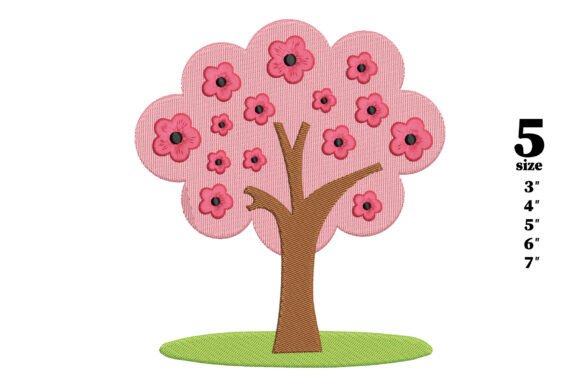
Tree with Flowers
A Designer’s First Impression: Graceful, Not Fussy
When I opened Tree with Flowers for the first time, I didn’t see a generic floral motif—I saw a quiet confidence in its balance. The trunk has gentle taper and subtle texture, not rigid symmetry; the branches arc outward like breath, not rigidity. Blooms cluster organically—not evenly spaced, not overly dense—so it reads as hand-drawn, not algorithmically arranged. It lands somewhere between botanical illustration and folk art: elegant enough for a bridal tea towel, warm enough for a baby onesie. That duality is rare—and valuable.
Real-World Test: Stitching It on a Linen-Cotton Tote Bag
Last week, I used Tree with Flowers for a custom order: a medium-weight linen-cotton tote for a local florist’s pop-up shop. I chose a 4.5" hoop size and paired it with tear-away + light cutaway stabilizer. The design stitched cleanly—no thread breaks, no puckering—even across the fabric’s natural slub. The satin-stitched flower centers held shape without stiffness; the fill-stitched leaves had soft gradation, not a flat block of color. Customers paused mid-browse to trace the trunk with their fingers. That’s the sign: it doesn’t just *look* handmade—it *feels* intentional, considered, quietly special.
Where It Shines (and Why)
- Custom apparel: On a relaxed-fit sweatshirt, the scale reads clearly from three feet away—no tiny details lost in knit texture. The open branch structure avoids heavy stitch density that can stiffen shoulders or elbows.
- Baby embroidery: Soft curves and rounded petals suit onesies and burp cloths. No sharp points or tight corners that snag during washing or wear.
- Embroidered patch: Clean outer edges and moderate stitch count make it ideal for iron-on or sew-on patches—no fraying risk at the perimeter.
- Holiday & wedding gifts: Works year-round: add holly berries for December, cherry blossoms for spring, or neutral ivory thread for a minimalist vow book cover.
- Etsy seller asset: It photographs well in natural light—no harsh shadows or muddy fills—so your digital embroidery file previews convert better. Pair it with a simple “personalized with name” listing and you’ve got a repeatable, brand-consistent bestseller.
Use With Care: Practical Boundaries
Tree with Flowers isn’t magic—it’s thoughtful design, and that means knowing its limits. On ultra-thin cotton (like handkerchief weight), I’d reduce stitch density manually or skip the inner petal fills entirely—otherwise, the fabric can sheer or distort. On dark fabrics, test contrast first: some thread brands mute pastel pinks or pale yellows. On stretchy knits (think t-shirt blanks), use a firm cutaway stabilizer *under* and *on top*—the branch lines need support where fabric moves. And avoid placing it directly over seams or curved areas like cap crowns unless you’ve tested hooping stability first—the trunk base must sit flat, or the whole composition tilts.
Design Notes Every Embroidery Professional Should Check
- Run a test stitch on scrap fabric *identical* to your final project—linen behaves differently than denim, even if weight seems similar.
- Review thread colors in both daylight and warm indoor light. A blush pink can read lavender under LED bulbs—misleading for client approvals.
- Zoom into the file: Are small stamens or leaf veins rendered as running stitch or satin? If they’re too narrow (<0.8mm), they may vanish on textured fabric.
- Confirm hoop size compatibility with your machine—and whether the design fits comfortably inside, not crammed to the edge. Crowding invites misalignment.
- Check licensing before uploading to your Etsy shop as a digital embroidery file. “High-quality, fun, and easy to stitch” doesn’t tell you if commercial resale is permitted.
- Mock it up in black-and-white first. If the silhouette loses legibility without color, reconsider placement or scaling.
Why This Design Builds Trust—Not Just Decoration
When a customer orders a personalized gift—a baby blanket with Tree with Flowers stitched beside the child’s name—they’re not buying thread and fabric. They’re buying reassurance: that this moment feels seen, tender, and enduring. The design delivers that because it avoids trend-chasing clichés. No glitter fonts. No cartoonish stems. Just grounded elegance. That translates directly to perceived value: buyers pay more for items that feel *designed*, not assembled. For small shop owners, that means higher margins. For craft fair sellers, it means longer conversations and fewer “just looking” exits. For apparel decorators, it means clients return for seasonal variations—not one-off experiments.
Final Thought: A Workhorse with Soul
Tree with Flowers belongs in your core design assets—not as a novelty, but as a reliable voice in your creative vocabulary. It works equally well as a standalone statement on a pillow cover or as part of a larger garden-themed collection (pair it with hummingbird or butterfly motifs from the same Floral Garden category for cohesive branding). It elevates a plain tea towel into a boutique product. It softens the industrial feel of a work apron. And yes—it stitches cleanly on a $12 canvas tote, which matters when you’re turning craft into commerce. It’s not flashy. It’s faithful. And in embroidery, that kind of quiet consistency is what turns casual buyers into loyal fans.