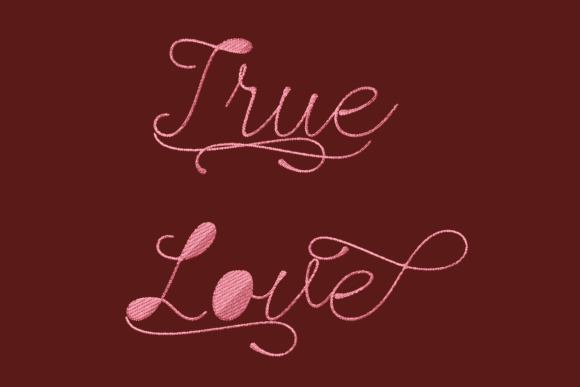
True Love: A Smart Choice for Small Business Embroidery
First Impression: Casual Elegance with Vintage Authenticity
As an embroidery designer who’s digitized and stitched thousands of designs for small businesses, my first reaction to True Love was immediate recognition—it reads as both warm and refined. The description calls it “casual and elegant” with an “authentic and vintage look,” and that lands perfectly. This isn’t a flashy script or a stiff serif; it’s a lettering design that feels hand-drawn yet precisely balanced—ideal for brands wanting approachability *and* polish. Think of a local florist’s apron, a boutique bakery’s tote bag, or a pet studio’s staff cap: True Love adds sincerity without sacrificing professionalism.
Where True Love Shines in Real Business Use
True Love excels where small businesses need quiet confidence—not loud branding. On embroidered patches, its clean line weight and open spacing hold up beautifully at 2.5"–3.5", making it perfect for sew-on chest logos on uniforms or iron-on accents on reusable shopping bags. For custom apparel like work shirts or aprons, the design’s moderate height and generous letter spacing prevent crowding, even when stitched on textured canvas or medium-weight twill.
Cap embroidery? Yes—but best reserved for mid-crown front placement (not curved bill fronts) where the gentle curves of the letterforms read clearly. As a sleeve detail on café staff tees or a subtle corner accent on handmade product packaging, True Love elevates perceived value without overwhelming. Etsy sellers love this kind of design: it pairs seamlessly with printable mockups, supports cohesive design assets across listings, and reinforces a handmade product aesthetic customers trust.
For wedding-related small businesses—think invitation studios, vow book makers, or bridal boutiques—True Love fits naturally within the Wedding Quotes category while avoiding cliché. It works just as well for non-wedding contexts: a ceramicist stamping mugs, a candle maker labeling gift boxes, or a florist embroidering linen napkins. Its versatility is its business strength.
Use With Care: Practical Limits for Reliable Results
Like any quality machine embroidery design, True Love has sweet spots—and boundaries. Avoid scaling it below 1.75" for patches: fine interior details and tight kerning may collapse under stitch density, especially on dense fabrics or with low-quality stabilizer. Cap fronts with aggressive curvature will distort the baseline; test on a cap blank before bulk production. Dark uniforms demand high-contrast thread colors—navy with cream or charcoal with pale gold reads better than black-on-black.
High-stitch-density areas (like overlapping serifs or thick terminals) can cause puckering on lightweight knits or loosely woven linens. Always pair True Love with cutaway or tear-away stabilizer appropriate for your fabric texture—not generic “all-purpose.” And never skip testing on the *exact* garment or patch backing you’ll use: thread tension, needle size, and hoop pressure all impact how gracefully the vintage character translates to the finished product.
How True Love Strengthens Brand Identity & Customer Trust
In small business merch, typography is silent storytelling. True Love signals care, authenticity, and attention to craft—qualities customers associate with premium handmade product experiences. When stitched consistently across aprons, tote bags, and staff caps, it builds visual consistency that boosts brand recognition faster than complex logos. That familiarity breeds trust: a customer seeing True Love on a barista’s apron *and* their takeaway bag subconsciously registers cohesion, reliability, and intentionality.
It also invites engagement. Unlike corporate sans-serifs, True Love feels personal—ideal for businesses built on relationships (florists, pet sitters, local studios). Used thoughtfully, it turns functional items—like a reusable tote or embroidered keychain—into keepsakes. That emotional resonance increases perceived product value and encourages repeat purchases and word-of-mouth sharing.
Pro Designer Notes Before You Stitch
- Test in black and white first: Print a grayscale version to assess contrast and spacing before digitizing or stitching.
- Verify small-patch viability: Resize to your target patch dimensions and check legibility—especially the lowercase “e” and “o” in “Love.”
- Review thread color contrast: Run a sample on your actual fabric with intended thread colors—light threads on dark backgrounds often need extra underlay.
- Inspect kerning and spacing: Tight letters like “Tr” and “ov” must retain breathing room at production scale.
- Confirm hoop size compatibility: Ensure your embroidery file fits standard hoops used for caps, totes, and uniforms.
- Test on real fabric: Stitch a full sample on the exact material—cotton duck, denim, polyester twill—to evaluate drape, stiffness, and stitch definition.
- Use proper stabilizer: Match stabilizer weight and type to fabric texture and end-use (e.g., cutaway for stretchy knits, tear-away for stable wovens).
- Create a client-approved mockup: Show how True Love looks on a realistic digital mockup before committing to production.
- Compare beside other design assets: Place it next to your logo, icons, and packaging fonts to ensure harmony across touchpoints.
- Confirm commercial licensing: Verify the digital embroidery file includes rights for small business merch, embroidered patch resale, and commercial embroidery use—don’t assume.
Final Thought: More Than Just Lettering
True Love isn’t just another embroidery file—it’s a strategic design asset. When applied intentionally across small business merch, it quietly communicates values: sincerity, craftsmanship, and human-centered service. Whether you’re a solo craftsperson launching on Etsy or a local studio outfitting your team, this design earns its place not through novelty, but through reliable, elegant performance. In the world of custom apparel and branded patches, that kind of quiet confidence is rare—and invaluable.